Why I studied materials science
I studied materials science and engineering, partly because I didn't quite understand the university admissions system of the UK (being based in France), and partly because I didn't believe I would be offered a place in the more competitive physics degree programme.
Shame, really.
It seemed simply a way to continue learning physics, chemistry and mathematics. In truth, not quite. I ended up finding anything related to real materials rather dull. Metals and ceramics in particular. I spent three hours on my first day grinding and polishing a small piece of brass to look at it under a microscope, blinded by awfully bright neon lights. Was this what I'd signed myself up for?
When offered glimpses at what kind of jobs we could do afterwards, our cohort was given talks by representatives of bp, Shell, and Rolls-Royce. In short, I could help oil and gas companies keep extracting more hydrocarbons by preventing their pipelines from getting rusty. Or, I could help design aircraft engines in one of England's former coal-mining basins. I admit neither prospect appealed to me.
Seriously considering dropping out and returning to France, I found hope in a set of academics in my department doing theory and simulation of materials. They typically had trained as physicists and weren't afraid of abstract mathematics. This was a promising sign to me.
Theory and simulation of materials is a field at the interface between condensed-matter physics and materials science. We try to understand the macroscopic and surface properties of materials by predicting their structure and behaviour at different length- of time-scales. Much of this field relies on performing simulations using high-performance computing facilities.
A significant part of these simulations are called first-principles, or ab initio, calculations. This is because they
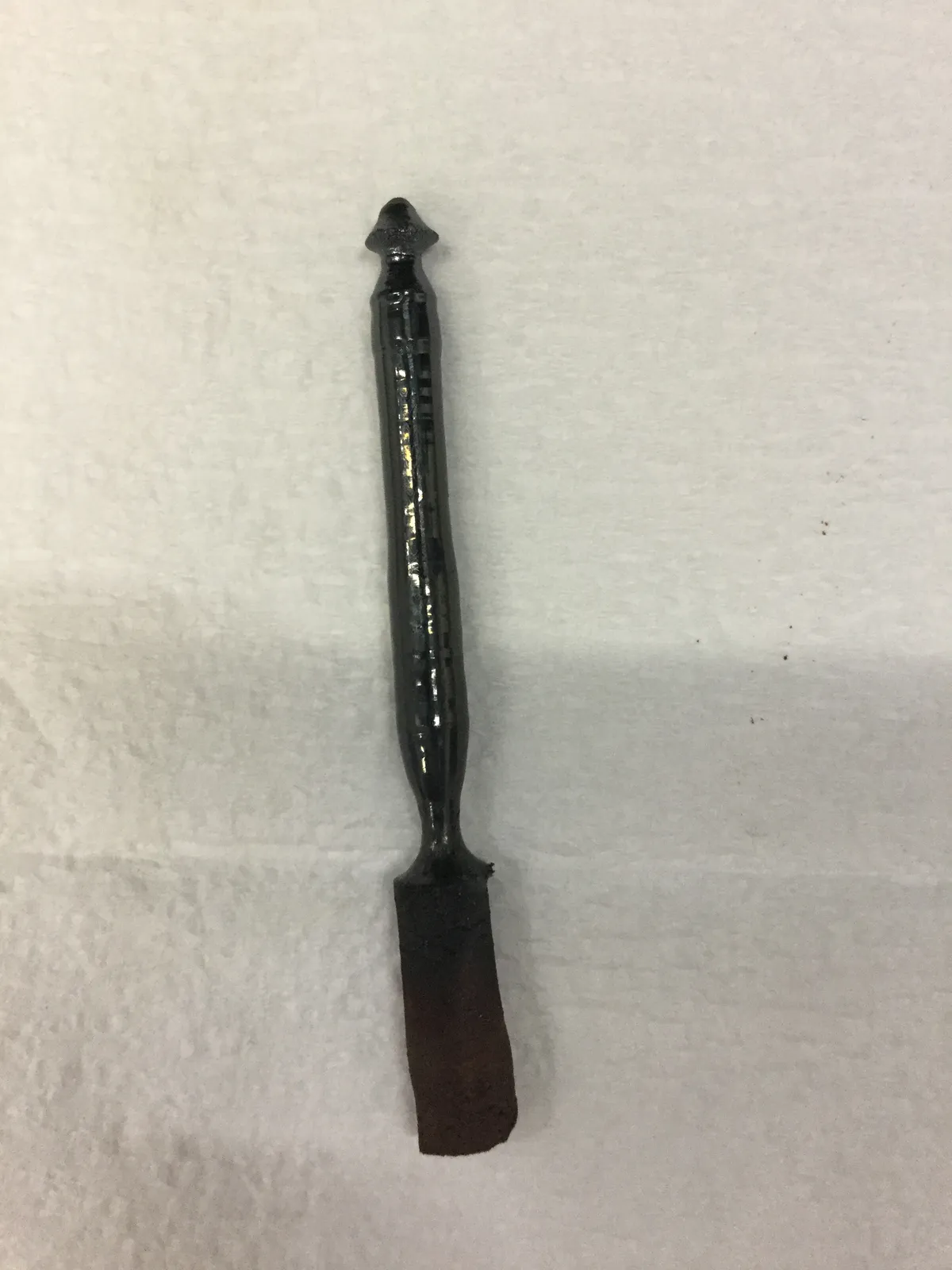
Single-crystal of LaFeO3 synthesised using a floating zone furnace. The shiny part is the single crystal, whereas the base is polycrystalline.