Why I wanted to study physics
I decided I wished to pursue a PhD in condensed-matter physics when I was 18-years-old. It was unusual to already know how I wanted to spend the next seven to eight years of my life.
My teenage years were spent becoming more and more fascinated by the power of mathematics at describing the world around us. I was sure that in theoretical physics there lay the key to understanding reality as it is. Uncovering the truth. It became all the more exciting as I discovered very powerful frameworks in mathematics: calculus, linear algebra, differential equations and, ultimately, calculus of variations.
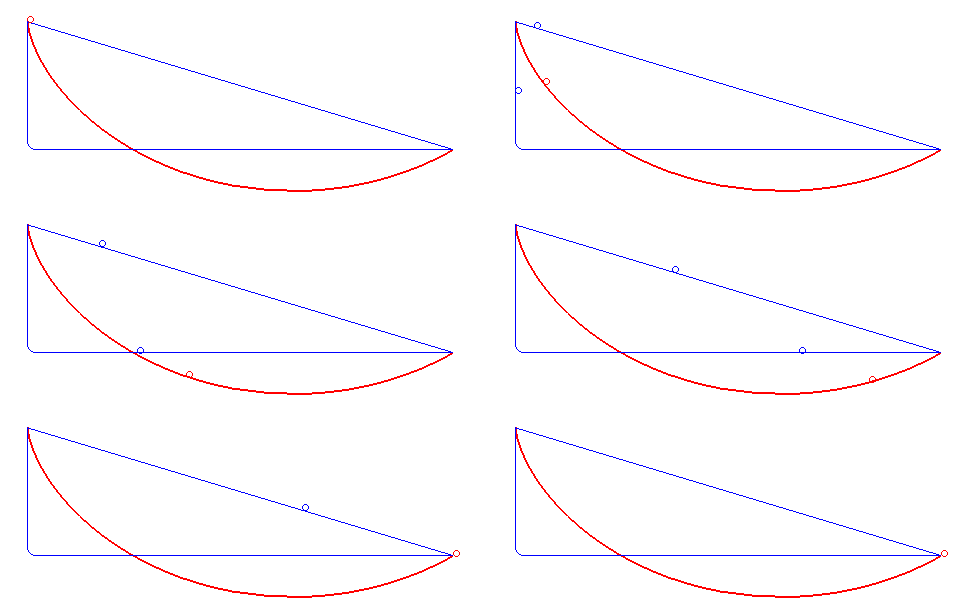
Calculus of variations stood out to me, especially because it lead to equations which contained and revealed the symmetry of the system under study. It was an elegant way to solve interesting problems, such as the brachistochrone problem. It opened the door to new formulations of classical mechanics: Lagrangian and Hamiltonian mechanics, which turned out to appear everywhere once I tried to dig deeper into quantum mechanics and quantum field theory.
I studied materials science and engineering, partly because I didn't quite understand the university admissions system of the UK (being based in France), and partly because I didn't believe I would be offered a place in the more competitive physics degree programme. Shame, really. It seemed simply a way to continue learning physics, chemistry and mathematics. In truth, not quite. I ended up finding anything related to real materials rather dull. Metals and ceramics in particular. I spent three hours on my first day grinding and polishing a small piece of brass to look at it under a microscope, blinded by awfully bright neon lights. Was this what I'd signed myself up for?
When offered glimpses at what kind of jobs we could do afterwards, our cohort was given talks by representatives of bp, Shell, and Rolls-Royce. In short, I could help oil and gas companies keep extracting more hydrocarbons by preventing their pipelines from getting rusty. Or, I could help design aircraft engines in one of England's former coal-mining basins. I admit neither prospect appealed to me.
[to be continued...]